


Climate Change Weekly - The Heartland Institute
In comparison with traditional electric power generating sources, such as coal, natural gas, nuclear, and hydroelectric, solar power has a tremendous land footprint per amount of electricity generated.
In general, as discussed in “Energy at a Glance: Solar Power” and “Affordable, Reliable, and Clean: An Objective Scorecard to Assess Competing Energy Sources,” research shows solar power requires more than three times as much land per megawatt of electricity produced than coal, natural gas, or nuclear. That’s three times more habitat disrupted or farmland taken out productive use for crop or livestock output, than other sources of power, under an apples-to-apples comparison that includes mining but may exclude waste disposal for solar, which isn’t usually accounted for in most analyses.
However, a recent study by the energy analysts at “Energy Bad Boys,” Isaac Orr and Mitch Rolling, suggests solar power’s land footprint is much larger than previously believed, and it gets worse as more solar is added to an area to replace existing coal or if natural gas is excluded as an alternative for increased power needs.
Framing their analysis, Orr and Rolling write,
Most public discussions about solar focus on energy production, but power systems are built around reliability during peak demand. Once you look at the grid through the lens of accredited capacity—that is, capacity that can be relied upon during peak demand—instead of annual energy, the land requirements for different technologies look radically different.
Orr and Rolling compared the land impact of a proposed 500-megawatt (MW) solar facility, the River City Energy Project, in Cerro Gordo County, Iowa, to an alternative combined-cycle natural gas facility.
The existing Emery Generating Station natural gas plant in Cerro Gordo County has a rated capacity of 602.8 MW. Looking at a “comparable” solar complex through the lens of accredited or peak capacity demanded over extended periods, Orr and Rolling calculated it would require more than 105,792 acres of solar panels, roughly 29 percent of the total land area of Cerro Gordo County. That’s far above the 2,894 acres planned for the project based on average capacity.
Just looking at installed capacity, the proposed 500 MW Ranger Power industrial solar facility proposed for Cerro Gordo County would require approximately 5.8 acres per MW of rated installed capacity. By contrast, the existing gas plant sits on approximately 0.096 acres per MW of installed capacity. Hence, solar requires about 60 times more land per MW of power produced. And of course that’s just counting installed capacity, not accredited or necessary peak load capacity.
The Midcontinent Independent System Operator (MISO), the regional transmission authority and market-clearing wholesaler in which Cerro Gordo County falls, recently updated its power rating system to reflect the reliability of all generating sources across its system during periods where the system is most likely to experience loss of load hours. Under its new Direct Loss of Load rating system, MISO concludes that by 2030 during the summer peak expected reliable solar power across its territory would amount to approximately 4 percent of the needed power, falling to just 2 percent by 2043, less than halfway through the expected operational life of a new power facility brought online. Over the course of the year, the numbers are even worse, with MISO estimating solar facilities will provide just 2.25 percent of accredited power, and less than 1 percent in 2043, far less than the 50 percent MISO estimated under its prior rating system.
By comparison, MISO anticipates natural gas facilities during the same periods, summer peak and annual, will produce 89 percent of accredited power during the summer in 2030, falling to 88 percent by 2043, and 82 percent on average across the entire year in 2030, falling to 81 percent in 2043. Natural gas is simply much more, massively more, reliable than solar power during peak demand periods, keeping in mind that solar falls off entirely at night and produces much less power than rated when it is cloudy, raining, or snowing.
With MISO’s new accreditation system in mind, to provide comparable power to a proposed 500 MW natural gas alternative would require many more acres than proponents of the River City Energy Project solar facility estimate.
Under MISO’s rating system, “19.29 acres of solar panels would be necessary for one MW of accredited capacity in the 2025-2026 planning year, compared to 0.14 acres for a combined cycle natural gas plant,” Orr and Rolling estimate.
“In 2030 and 2033, it would require 257.24 acres of solar panels for one MW of accredited capacity, growing to 578.80 acres in 2043,” the Energy Bad Boys continue. “In comparison, natural gas would require 0.14 acres, 0.14, and 0.14 acres in 2030, 2033, and 2043, respectively.”
That means the solar facility would require nearly 1,838 percent more acreage to produce the same amount of reliable power as a gas plant.
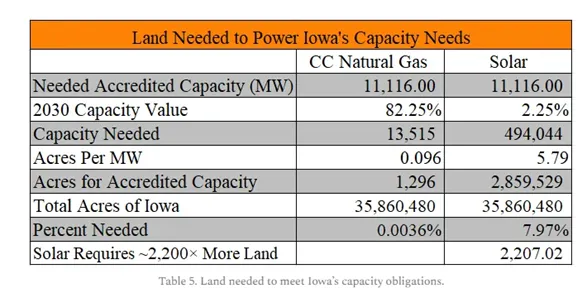
The researchers expanded their analysis to Iowa as a whole. The table below tells the tale:
Elsewhere, these numbers will vary a bit based on geographic location and climate. New Mexico and Arizona get more sun annually than Iowa, after all. However, it won’t make a huge difference, because peak demand is higher in the sunnier and hotter states. Also, the performance of solar panels drops off considerably during periods of extreme heat. Solar panels experience a 0.30 to 0.50 percent efficiency loss for every degree Celsius above 77℉, amounting to a decline of 10 to 25 percent of their efficiency during extended periods of extreme heat.
The latter point is important because if ongoing climate change causes more extremely hot days and increased numbers of extended heat waves in the future, as climate models have projected—although experience and data have not borne this prediction out so far—then solar energy, one supposed solution to power modern society faced with a changing climate, will be less effective than promised. The more the Earth warms, specifically the higher the number of very hot days, the less effective solar energy is as a climate solution. Electricity providers have to add more and more panels, and thus cover more and more wildland and farmland with them, to make up for the efficiency losses solar experiences as temperatures exceed 77℉, which really is not that hot.
In short, regardless of whether one considers only the stated rated capacity or includes the more important accredited capacity, anyone who cares about land conservation and open spaces should reject new solar when considering how to satisfy the growing demand for steady electric power.
Sources: Energy Bad Boys;Energy at a Glance